
Gunpowder, one of the four great inventions of ancient China, was invented during the Tang Dynasty in the 9th century AD, and has a history of thousands of years. It originated from the experiments of ancient alchemists and was an accidental product in the pursuit of elixirs of immortality, but it has had a profound impact on the military, industry, and daily life. From being used to make fireworks in the early days to changing the war situation later, the development of gunpowder has not only profoundly influenced Chinese history, but also spread to all parts of the world through the Silk Road and other channels, promoting the progress of human civilization and leaving a strong mark on the world historical stage.
The origins of gunpowder
The birth of gunpowder is closely linked to ancient Chinese alchemy. In order to make elixirs of immortality, ancient alchemists constantly tried to mix and heat various minerals, plants and other substances. During the long-term experiment, they found that when sulfur, saltpeter (potassium nitrate) and charcoal were mixed in a certain proportion, they would produce a violent combustion or even explosion reaction, which was the prototype of gunpowder. According to historical records, at the latest in the middle of the Tang Dynasty, alchemists had clearly recorded the formula and characteristics of gunpowder, but at that time it was mainly regarded as a magical substance and had not yet been put into practical use.

How did gunpowder develop?
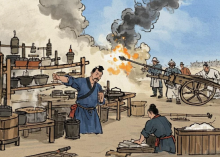
In the late Tang Dynasty, gunpowder began to be gradually used in the military field. Initially, people put gunpowder in bamboo tubes or paper tubes to make simple incendiary firearms, which were used for arson and deterrence in war. For example, in some siege battles, soldiers would throw ignited gunpowder tubes into the enemy camp, causing chaos and fire. Although the power of gunpowder weapons at this time was limited, it marked an important transition of gunpowder from the laboratory to practical application.
Large-scale use of gunpowder
The Song Dynasty was a critical period for the development of gunpowder. At that time, the Song Dynasty faced military threats from neighboring regimes, and the demand for military technology led to the rapid development and large-scale application of gunpowder weapons. During the Northern Song Dynasty, the government established an institution dedicated to the manufacture of firearms.
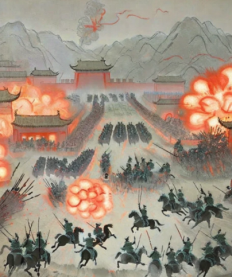
During this period, the types of gunpowder weapons continued to expand. In addition to early incendiary firearms, explosive firearms such as “Thunderbolt Cannon” and “Thunderbolt Thunderbolt” also appeared. “Thunderbolt Cannon” is a paper tube wrapped with gunpowder and gravel. After ignition, the impact force generated by the explosion of gunpowder will throw the gravel out, which has a certain killing and deterrent effect; “Thunderbolt Thunderbolt” is an iron shell bomb with gunpowder inside. After detonation, it can produce a huge explosive power, causing serious damage to enemy walls, soldiers and equipment.
The spread and impact of gunpowder
In the 13th century, with the expansion of the Mongol Empire and trade along the Silk Road, gunpowder and gunpowder weapons gradually spread to the Arab region and Europe. Through battles with the Mongol army and trade activities, the Arabs mastered the production methods of gunpowder and the use of firearms, and spread them to the Middle East and North Africa.
After gunpowder was introduced to Europe, it triggered a huge change in the military field. European craftsmen continued to improve and innovate on the basis of absorbing Chinese gunpowder technology. They made more advanced artillery and muskets. The emergence of these firearms broke the defense system of medieval feudal castles in Europe. The castles that were once indestructible became vulnerable under the bombardment of artillery, and the dominant position of the knight class was also impacted, which accelerated the collapse of the feudal system in Europe.
In addition to the military field, gunpowder also played an important role in industry and daily life. In the mining industry, gunpowder was used to blast rocks, improving the efficiency of ore mining; in the construction field, gunpowder was used to demolish large buildings and excavate mountains, promoting the development of infrastructure construction. In addition, gunpowder technology also promoted the development of European chemistry, metallurgy and other disciplines, laying the technical foundation for the subsequent industrial revolution.
Gunpowder is a great invention of ancient China. From accidental discovery to continuous improvement and application, and then to spreading around the world and profoundly changing human history, it demonstrates the wisdom and creativity of the ancient Chinese people. Its development process is not only a technological advancement, but also a witness to the exchange and integration between different civilizations. It still plays a far-reaching role in the development of human civilization.