Europe’s history is a complex tapestry woven with threads of grand empires, devastating conflicts, profound ideological shifts, and an enduring, often elusive, dream of unity. From the foundational principles of ancient republics to the intricate diplomatic chessboards of modern statecraft, the continent has continuously redefined its political landscape. This pillar page embarks on a comprehensive journey through the pivotal moments and figures that have shaped Europe’s power dynamics, examining how ancient ambitions, revolutionary ideals, and strategic diplomacy have forged the continent we know today. We will delve into the rise and fall of dominant powers, the ideological confrontations that sparked revolutions, and the persistent efforts to establish a lasting peace and collective identity.
Ancient Foundations: The Roman Republic’s Rise and Fall
The genesis of many European political ideas and structures can be traced back to the Roman Republic, a formidable power that expanded its influence across the Mediterranean world. Its republican ideals, though eventually succumbing to internal pressures, laid significant groundwork for future governance models. The period was characterized by a delicate balance of power among various social classes, enshrined in its complex system of magistrates, Senate, and popular assemblies. However, this intricate system was perpetually tested by the ambitions of powerful individuals and the growing disparities within Roman society.
The Republican Ideal and its Internal Strife
The Roman Republic, established in 509 BCE, was founded on principles designed to prevent the concentration of power seen under the preceding monarchy. It featured a system of checks and balances, with two consuls at the head, advised by the Senate, and various assemblies representing the plebeians and patricians. This framework, however, was not immune to internal tensions. The expansion of the Republic brought immense wealth but also exacerbated social inequalities, creating a volatile environment where traditional norms were increasingly challenged. Economic pressures, land distribution issues, and the integration of diverse conquered populations strained the republican fabric.
- Checks and Balances: The system of elected magistrates, senatorial oversight, and popular assemblies aimed to distribute power, but often led to gridlock and political infighting.
- Social Tensions: The growing chasm between the wealthy elite and the impoverished masses, particularly after military service drew citizens away from their farms, fueled populist movements.
- Military Reforms: Marius’s reforms professionalized the army, shifting soldiers’ loyalty from the Republic to their generals, a critical factor in the subsequent civil wars.
Caesar, Pompey, and the Civil Wars
The late Roman Republic was irrevocably plunged into a series of civil wars, with the confrontation between Julius Caesar and Gnaeus Pompeius Magnus being the most decisive. Both were immensely successful generals and political figures who commanded vast personal armies and client networks. Their rivalry was not merely a clash of personalities but represented a fundamental struggle over the future of the Roman state: whether it would remain a republic governed by traditional institutions or transition into a more centralized, autocratic system dominated by a single powerful figure. The political maneuvering, alliances, and betrayals leading up to the crossing of the Rubicon in 49 BCE highlight the deep fissures within the Roman elite.
- First Triumvirate: An unofficial political alliance between Caesar, Pompey, and Crassus initially aimed to consolidate their power, but ultimately sowed the seeds of future conflict.
- Crossing the Rubicon: Caesar’s decisive act of marching his army into Italy signaled an irreversible challenge to the Senate’s authority, triggering widespread civil war.
- Battle of Pharsalus (48 BCE): Caesar’s victory over Pompey in Greece marked a turning point, effectively ending the Republic’s ability to resist a single dominant leader and paving the way for the Principate.
- Legacy of Conflict: The civil wars dramatically accelerated the transition from Republic to Empire, demonstrating how unchecked ambition and military power could dismantle even well-established political systems.

The Dawn of a Unified Europe: Charlemagne and the Holy Roman Empire
Following the decline of the Western Roman Empire, Europe entered a period of fragmentation and shifting allegiances. It was in this tumultuous era that Charlemagne, King of the Franks, emerged as a unifying force, laying the foundations for what would become the Holy Roman Empire. His reign represented a powerful, albeit brief, resurgence of imperial ambitions and a significant attempt to recreate a unified Christian Europe. This era established a concept of shared European identity rooted in Roman imperial legacy and Christian faith, a dream that would echo for centuries.
Charlemagne’s Vision and Imperial Ambition
Charlemagne’s reign (768-814 AD) was marked by relentless military campaigns that expanded the Frankish kingdom across much of Western and Central Europe. His conquests were not merely about territorial gain but were intertwined with a vision of a renewed Roman Empire, buttressed by Christian doctrine and culture. The coronation of Charlemagne as Emperor of the Romans by Pope Leo III on Christmas Day 800 AD in Rome was a symbolic act of immense significance, asserting a new spiritual and political authority in the West, independent of the Byzantine Empire. This act solidified the alliance between the Papacy and the Frankish monarchy, creating a powerful new axis in European politics.
- Military Expansion: Campaigns against the Lombards, Saxons, Avars, and Moors dramatically increased Frankish dominion, stabilizing borders and extending Christian influence.
- Cultural Revival (Carolingian Renaissance): Charlemagne fostered a period of intellectual and artistic revival, promoting literacy, establishing schools, and standardizing religious practices, which helped to consolidate his vast empire.
- Administrative Innovation: He implemented a centralized administration through counts and missi dominici (royal envoys) to ensure governance and loyalty across his diverse territories.
- Imperial Coronation (800 AD): This event formally established Charlemagne as a successor to the Roman emperors, bestowing immense prestige and legitimizing his authority over a vast, multi-ethnic realm.
The Enduring Legacy of the Holy Roman Empire
While Charlemagne’s empire fractured after his death, the ideal of a pan-European Christian empire persisted, finding its most enduring expression in the Holy Roman Empire. This entity, though often decentralized and marked by internal conflicts between emperors and popes, remained a central feature of European politics for over a thousand years, from its official establishment in 962 AD under Otto I until its dissolution in 1806 by Napoleon. The Holy Roman Empire was a complex mosaic of kingdoms, duchies, principalities, and free cities, held together by a shared imperial tradition and a tenuous loyalty to the emperor. Its very existence represented a continuous, if often frustrated, aspiration for a unified European political and cultural space.
- Decentralized Structure: Unlike a modern nation-state, the HRE was a loose confederation, where the emperor’s power often depended on his personal influence and dynastic holdings.
- Imperial-Papal Conflicts: The struggle for supremacy between the emperors and the papacy, particularly during the Investiture Controversy, profoundly shaped medieval European politics and the concept of secular versus spiritual authority.
- Cultural and Legal Influence: Despite its political fragmentation, the HRE fostered a common legal framework, artistic styles, and intellectual currents that contributed significantly to European identity.
- Symbol of Unity: Even in its later, weaker forms, the Holy Roman Empire remained a potent symbol of a unified Christian Europe, influencing later movements for continental integration.

The Age of Absolutism, Revolution, and Napoleonic Reshaping
The transition from the medieval to the early modern period witnessed profound shifts in European political thought and structure. The rise of absolute monarchies centralized power to an unprecedented degree, challenging traditional feudal systems and paving the way for the modern state. However, these monarchical systems eventually faced severe ideological confrontation from new republican experiments, fueled by Enlightenment ideals. The French Revolution and the subsequent Napoleonic Wars unleashed a torrent of change across the continent, dismantling old orders and redrawing the map of Europe, leading to a desperate attempt to restore stability at the Congress of Vienna.
Absolute Monarchy vs. Republican Ideals
The 17th and 18th centuries in Europe were largely defined by the dominance of absolute monarchies, where rulers like Louis XIV of France claimed divine right and exercised unchallenged authority over their realms. This system concentrated power within the royal court, leading to the development of powerful centralized bureaucracies and standing armies. However, the Enlightenment period gave rise to revolutionary ideas of popular sovereignty, individual rights, and republicanism, directly challenging the legitimacy of absolute rule. Thinkers like Rousseau, Montesquieu, and Locke provided the intellectual ammunition for movements that sought to replace inherited power with representative government. The American Revolution served as a practical example, inspiring European revolutionaries.
- Characteristics of Absolutism: Centralized power, divine right theory, powerful standing armies, state control over economy and religion, exemplified by France under Louis XIV and Russia under Peter the Great.
- Enlightenment Challenge: Philosophers advocated for reason, individual liberty, and government by consent, directly undermining the foundations of absolute monarchy.
- Republican Experiments: The British Glorious Revolution (1688), the American Revolution (1776), and most significantly, the French Revolution (1789), demonstrated the viability and challenges of republican governance.
Napoleon’s Wars and Europe’s Shifting Landscape
The French Revolution, initially a republican experiment, soon spiraled into radicalism and ultimately gave rise to Napoleon Bonaparte, whose military genius and imperial ambitions fundamentally reshaped Europe. Napoleon’s conquests spread revolutionary ideals such as legal equality and secular governance, dismantling the remnants of feudalism across the continent. His campaigns led to the abolition of the Holy Roman Empire, the creation of new kingdoms and confederations, and the widespread adoption of the Napoleonic Code. While his reign ended in defeat, his legacy irrevocably altered political boundaries, national identities, and military strategies, forcing European powers to reconsider their policies of neutrality and expansion.
- Spread of Revolutionary Ideals: Napoleon’s armies carried principles of liberty, equality, and fraternity, along with secular legal codes, across Europe, disrupting old aristocratic orders.
- Territorial Reorganization: The Napoleonic Wars led to significant redrawing of maps, including the dissolution of the Holy Roman Empire and the creation of the Confederation of the Rhine.
- Rise of Nationalism: Resistance to French occupation inadvertently fostered stronger national identities in regions like Germany and Spain, laying groundwork for future unification movements.
- Military Innovation: Napoleon’s strategies revolutionized warfare, emphasizing speed, mass mobilization, and decisive battles, influencing military doctrine for generations.
The Congress of Vienna and the Balance of Power
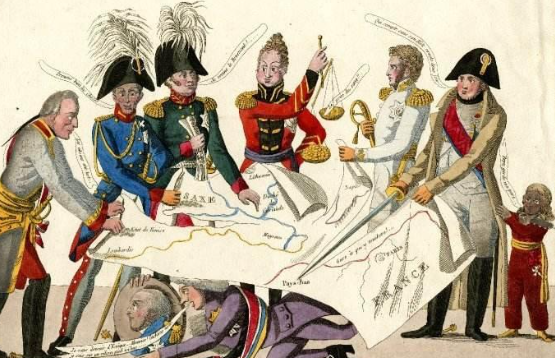
After Napoleon’s final defeat, the major European powers convened the Congress of Vienna (1814-1815) to restore order and stability to a continent ravaged by decades of war. Led by figures like Metternich of Austria, Talleyrand of France, and Castlereagh of Britain, the Congress aimed to establish a new “balance of power” to prevent any single nation from dominating Europe again. This involved redrawing borders, restoring legitimate monarchies, and creating a system of alliances and diplomatic cooperation known as the Concert of Europe. The Congress meticulously addressed territorial claims and sought to contain future revolutionary impulses, though its conservative nature would eventually clash with emerging nationalist and liberal movements.
- Legitimacy and Compensation: The principle of restoring pre-Napoleonic monarchies was central, alongside territorial adjustments to compensate victorious powers.
- Creation of Buffer States: States like the Kingdom of the Netherlands and the Kingdom of Piedmont-Sardinia were strengthened to contain potential French aggression.
- The Concert of Europe: An informal system of consultation and cooperation among great powers designed to maintain peace and suppress revolutionary movements, ensuring collective security.
- Lasting Impact: The Congress of Vienna established a framework that largely prevented major European-wide wars for nearly a century, though it also suppressed national aspirations that would later erupt.

National Unification and Realpolitik: Germany’s Path
The 19th century was a period defined by the powerful currents of nationalism, leading to the unification of several fragmented regions into powerful new nation-states. Among the most significant was the unification of Germany, a complex process driven by strategic political maneuvering and military might. This era saw the rise of “Realpolitik,” a pragmatic approach to foreign policy focused on national interest rather than ideology, epitomized by Otto von Bismarck. The path to German unity also highlighted the divergent historical choices and identities of its major constituents, particularly Prussia and Austria.
Bismarck’s Iron Diplomacy and German Unification
Otto von Bismarck, Prussia’s cunning Chancellor, masterfully orchestrated the unification of Germany through a series of calculated wars and diplomatic maneuvers from 1862 to 1871. His approach, known as Realpolitik, prioritized practical considerations and power over moral or ideological concerns. Bismarck understood that Prussian military strength was paramount, and he skillfully used it to achieve his political aims. He provoked limited wars against Denmark, Austria, and France, each serving to consolidate Prussian dominance and rally the disparate German states under Prussian leadership. His “iron and blood” speech perfectly encapsulated his belief that only decisive action, not parliamentary debate, would achieve national goals.
- Danish War (1864): Prussia and Austria jointly defeated Denmark, gaining Schleswig and Holstein and setting the stage for future Austro-Prussian rivalry.
- Austro-Prussian War (1866): Bismarck engineered a swift victory over Austria, dissolving the German Confederation and establishing Prussian hegemony over northern Germany. This crucial conflict removed Austria as a rival for leadership among German states.
- Franco-Prussian War (1870-1871): Bismarck skillfully provoked France into war, leveraging German nationalist sentiment to unite the southern German states with the North German Confederation. The decisive Prussian victory led to the proclamation of the German Empire in Versailles.
- Balance of Power and Isolationism: After unification, Bismarck shifted to a policy of maintaining peace through a complex web of alliances designed to isolate France and prevent any major European conflict, showcasing his diplomatic genius.
Austria and Germany: Divergent National Identities
The process of German unification starkly highlighted the “two paths of the German family” – the distinct historical trajectories of Austria and the newly formed German Empire. Austria, a multi-ethnic empire with a long history as the leading German power within the Holy Roman Empire, pursued a “Grossdeutschland” (Greater Germany) solution that included its German-speaking territories. However, Bismarck’s “Kleindeutschland” (Lesser Germany) strategy deliberately excluded Austria, focusing instead on Prussian leadership of the smaller German states. This divergence was rooted in centuries of separate development, different dynastic interests (Habsburg vs. Hohenzollern), and the multi-ethnic nature of the Austrian Empire, which made its full integration into a German nation-state problematic. The Austro-Prussian War cemented this separation, leading Austria to reorient its focus towards its Balkan territories and ultimately transforming into the Austro-Hungarian Empire.
- Grossdeutschland vs. Kleindeutschland: The fundamental debate over whether a unified Germany should include or exclude Austria, reflecting differing visions of German national identity.
- Habsburg vs. Hohenzollern: The dynastic rivalry between Austria’s ruling Habsburgs and Prussia’s Hohenzollerns was a key factor in the struggle for German leadership.
- Multi-ethnic Austrian Empire: Austria’s diverse population of Germans, Hungarians, Czechs, Poles, and others made it unsuitable for a purely German nation-state, contrasting with Prussia’s more ethnically homogenous core.
- Consequences of Exclusion: Austria’s exclusion from the German Empire led to its internal restructuring as the Austro-Hungarian Dual Monarchy, significantly impacting Central European politics.

The Dark Chapters: Totalitarianism and Imperial Collapse
The 20th century cast a long shadow over Europe, marked by unprecedented conflicts and the rise of destructive political ideologies. The devastating World Wars led to the collapse of ancient empires and the emergence of totalitarian regimes that sought absolute control over every aspect of society. The fall of the Tsarist empire in Russia and the subsequent birth of the Soviet Union, alongside the horrific centralization of power in Nazi Germany, represent some of the darkest, yet most instructive, periods in European history regarding the dangers of unchecked state power and ideological extremism.
Nazi Germany: Centralization of Power and Social Control
Nazi Germany under Adolf Hitler exemplified an extreme form of totalitarianism, where the state exerted absolute control over its citizens’ lives, thoughts, and actions. This was achieved through a ruthless centralization of power, the systematic dismantling of democratic institutions, and the creation of a pervasive apparatus of social control. The Nazi regime employed propaganda, censorship, secret police (Gestapo), and concentration camps to enforce ideological conformity and eliminate dissent. Every aspect of society, from education and media to labor and leisure, was co-opted to serve the state’s objectives, particularly its racial ideology and expansionist ambitions. The political operating model of Nazi Germany demonstrated the terrifying efficiency with which a modern state could subjugate its population through terror and manipulation.
- One-Party Rule: The Nazi Party eliminated all political opposition, establishing a single-party dictatorship with Hitler as the undisputed Führer.
- Propaganda and Censorship: Josef Goebbels’ Ministry of Public Enlightenment and Propaganda controlled all forms of media, art, and culture to indoctrinate the populace and demonize “enemies.”
- Terror Apparatus: The SS and Gestapo used arbitrary arrests, torture, and extrajudicial killings to suppress any form of opposition or perceived threat to the regime.
- Racial Ideology: Anti-Semitism and the concept of an “Aryan master race” were central to Nazi ideology, leading to the systematic persecution and genocide of Jews and other minority groups.
- Economic Control: The state directed the economy towards rearmament and autarky, prioritizing military strength over consumer welfare.
The Russian Empire’s Demise and the Soviet Union’s Birth
The fall of the Russian Empire, one of Europe’s longest-standing monarchies, and its transformation into the Soviet Union, represents another monumental shift in European power. Decades of internal unrest, economic hardship, and military defeats culminated in the 1917 Russian Revolutions. The February Revolution overthrew the Tsarist autocracy, establishing a provisional government. However, this was quickly supplanted by the Bolshevik Revolution in October, led by Vladimir Lenin, who promised “Peace, Land, and Bread.” The subsequent Russian Civil War (1917-1922) saw the Bolsheviks consolidate power, leading to the formation of the Union of Soviet Socialist Republics (USSR) in 1922. This new state was founded on Marxist-Leninist ideology, advocating for a global communist revolution and establishing a highly centralized, authoritarian system that would become a major geopolitical force for the next seven decades.
- Tsarist Autocracy: The deeply entrenched absolute monarchy faced mounting pressure from social unrest, industrialization, and political dissent.
- World War I Strain: Russia’s disastrous performance in WWI exacerbated economic and social problems, contributing directly to the collapse of the Tsarist regime.
- February Revolution (1917): Spontaneous uprisings led to the abdication of Tsar Nicholas II and the establishment of a Provisional Government.
- October Revolution (1917): The Bolsheviks, under Lenin, seized power, promising radical social and economic reforms.
- Russian Civil War: A brutal conflict between the Bolshevik “Reds” and anti-Bolshevik “Whites” (supported by foreign powers) resulted in Bolshevik victory and the consolidation of communist rule.
- Formation of the USSR (1922): The establishment of the Soviet Union marked the birth of the world’s first socialist state, profoundly impacting global politics and ideology.

The Modern Quest for Unity: From HRE to the European Union
Despite centuries of conflict and division, the dream of a unified Europe has never truly faded. From the ambitious, albeit flawed, vision of Charlemagne’s empire to the intricate institutional architecture of the modern European Union, the continent has consistently grappled with the challenge of achieving cohesion amidst diversity. This persistent quest for unity, often born out of the ashes of devastating wars, represents a unique aspect of European political history, reflecting a desire to transcend national rivalries for collective peace and prosperity. The journey from the Holy Roman Empire to the European Union illustrates a long-term evolution in the understanding and implementation of continental integration.
The Historical Continuity of European Integration
The notion of a unified European entity, whether under a single emperor or through cooperative governance, has a deep historical lineage. The Holy Roman Empire, despite its often-fragmented reality, served as a powerful symbolic anchor for a shared Christian European identity for a millennium. Later, figures like Napoleon, though through conquest, inadvertently spread common legal and administrative principles that fostered a sense of continental interconnectedness. In the wake of two devastating World Wars, the imperative for peace and economic cooperation became overwhelmingly clear. Visionaries like Jean Monnet and Robert Schuman proposed concrete steps towards integration, starting with economic sectors, to make future wars “not merely unthinkable, but materially impossible.” This led to the creation of the European Coal and Steel Community in 1952, a crucial precursor to the modern EU.
- Post-War Imperative: The catastrophic human and economic costs of WWI and WWII spurred a strong desire for permanent peace and stability through integration.
- Economic Integration as a Foundation: The strategy began with pooling vital industrial resources (coal and steel) under a common authority, making war between former adversaries economically unfeasible.
- Gradual Expansion: The ECSC evolved into the European Economic Community (EEC) and later the European Union (EU), gradually expanding its scope from economic to political and social integration.
- Shared Values and Institutions: The EU is built on principles of democracy, human rights, and the rule of law, supported by institutions like the European Parliament, Commission, and Court of Justice.
Challenges and Future of European Cohesion
The European Union, while a monumental achievement in international cooperation, faces ongoing challenges to its cohesion and future direction. Economic disparities among member states, differing national interests, and the complexities of decision-making within a large, diverse bloc often test its unity. Events such as the Eurozone crisis, the refugee crisis, and Brexit have highlighted the fragility of integration and the persistent tension between national sovereignty and supranational governance. Despite these hurdles, the EU continues to pursue deeper integration, addressing issues ranging from climate change and digital transformation to security and foreign policy, striving to maintain its relevance and influence on the global stage. The dream of a unified Europe, while constantly evolving, remains a powerful driving force.
- Sovereignty vs. Supranationalism: The ongoing debate between member states retaining national control and delegating authority to EU institutions remains a core tension.
- Economic Disparities: Differences in economic performance and fiscal policies among member states can strain solidarity and lead to political friction.
- Migration and Border Control: Managing external borders and internal migration flows presents significant political and social challenges for the Union.
- Populism and Nationalism: The resurgence of nationalist and populist movements within member states often challenges the foundational principles and policies of European integration.
- Geopolitical Role: The EU strives to project a unified voice on global issues, but achieving consensus among 27 member states on foreign policy and defense remains complex.
The journey of Europe, from the Roman Republic’s ambitious but ultimately flawed experiment with self-governance to the complex, evolving structure of the European Union, is a testament to humanity’s enduring struggle with power, conflict, and the elusive quest for unity. Empires have risen and fallen, ideologies have clashed, and diplomatic strategies have continually reshaped the continent’s destiny. Yet, through it all, the threads of common heritage, shared challenges, and the aspiration for a more integrated future persist. Understanding this grand tapestry of European power is not merely an academic exercise; it offers critical insights into the forces