of the Sanskrit and Thai scripts we see today can actually be traced back to a common “ancestor” – the Brahmi script (Brāhmī)? Brahmi is one of the earliest writing systems in ancient India, dating back to the stone inscriptions of Emperor Ashoka in the 3rd century BC.
Early development and morphological features of Brahmi script
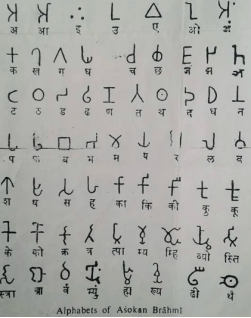
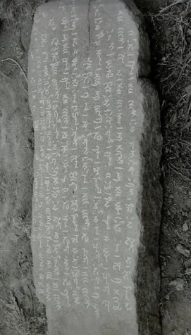
The early form of Brahmi script was relatively simple. The inscriptions on the Ashoka Pillar that have survived to this day give us a glimpse of its appearance. The characters carved on the stone pillars have simple strokes, rigid lines, and are mostly a combination of straight lines and arcs. The shapes of the letters are relatively simple, and each letter has a unique way of writing to express a specific phoneme.
For example, early vowels were represented by adding specific symbols to consonants, and this combination laid the foundation for the development of subsequent writing. As time went on, after the Maurya Dynasty, Brahmi writing began to change. The strokes of the letters gradually became rounder and the writing style became more fluent, showing that it was constantly evolving under the influence of social culture in different periods.
How did Brahmi script spread?
Brahmi script is widely spread in the Indian subcontinent. In Southeast Asia, such as Cambodia’s Khmer script and Thailand’s Thai script, the shadow of Brahmi script can be seen.
The Khmer script began to take shape around the 7th century AD. It borrowed the letter form and writing rules of the Brahmi script and combined it with the local language characteristics to create a unique writing system. The Thai script in Thailand also took the Brahmi script as a blueprint around the 13th century AD. After a series of transformations and improvements, it gradually formed the prototype of modern Thai.
What is the significance of the inheritance of Brahmi script?
In India, Brahmi script is the key carrier of Indian cultural inheritance. Hinduism, Buddhism and other religious classics use Brahmi script to spread their doctrines and promote the development and spread of religions. For example, during the spread of Buddhist classics in Asia, many early versions were written in Brahmi script, and then translated into multiple languages as Buddhism spread, which had a profound impact on the religious and cultural landscape of Asia.
Continuation of Brahmi script
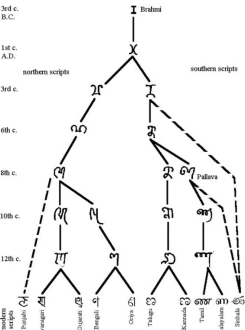
Although modern India uses a variety of scripts, such as Hindi and Tamil, they are all closely related to the Brahmi script. Hindi uses the Devanagari script, and its letter shapes and writing rules inherit the basic characteristics of the Brahmi script. However, in the long process of development, in order to adapt to the needs of modern languages, adjustments and improvements have been made in terms of the number of letters and spelling methods. Tamil, as an important script of the Dravidian language family, is also influenced by the Brahmi script in terms of its origin, although its language structure is different from Indo-European languages such as Sanskrit.